pillow_zx_spectrum
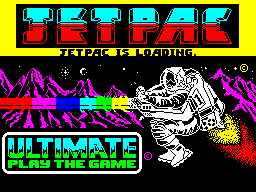 |
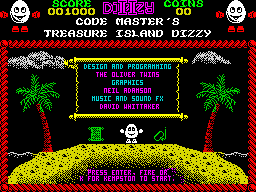 |
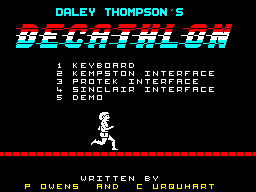 |
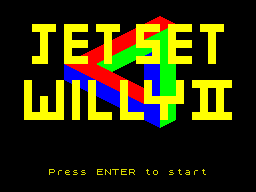 |
Pillow loaders for ZX Spectrum loading screens, extracted from tape, disk and snapshot files in the wild.
Open a tape, disk image, or snapshot with Image.open(...) and Pillow
gives you a 256×192 RGB image with the original Spectrum colours. Files
that contain multiple screens (multi-load games, multi-side disks)
expose them as Pillow frames via seek() / n_frames.
Install
pip install pillow_zx_spectrum
Usage
from PIL import Image
import pillow_zx_spectrum  # registers the plugins on import

img = Image.open("Glug Glug (1984)(CRL).tap")
img.save("loading-screen.png")
print(img.size)                   # (256, 192)
print(img.info["pixel_aspect_ratio"])  # (1, 1)
Multi-screen containers (disks, multi-load tapes) expose every screen they hold. Iterate with the stock Pillow helper:
from PIL import ImageSequence

img = Image.open("Moonwalker (Erbe).dsk")
print(img.n_frames)  # e.g. 2
for i, frame in enumerate(ImageSequence.Iterator(img)):
    frame.save(f"moonwalker.{i}.png")
Supported formats
2 id="supported-formats">Supported formatsTape
| Ext | Format | Notes |
|---|---|---|
.tap |
TAP | Plain ROM-loader block stream |
.tzx |
TZX | Versioned tape with timing/meta blocks; we extract from standard (0x10) and turbo-speed (0x11) data blocks. Custom-loader pure-data blocks (SpeedLock / BleepLoad / Alkatraz, block 0x14) are skipped — they need per-protection decoders. |
.scr |
SCREEN$ | Raw 6912-byte screen dump |
Disk
| Ext | Format | Notes |
|---|---|---|
.dsk |
CPC DSK | Spectrum +3 / Amstrad CPC, both standard and “Extended” variants. CP/M file system parsed (handles fragmented allocation). Auto-detects single/double-sided and various reserved-track conventions. |
.scl |
TR-DOS packed | “SINCLAIR” magic, compact distribution format used in Russian-speaking scene |
.trd |
TR-DOS raw | Sector-by-sector TR-DOS floppy dump; tolerant of truncated images |
.mgt |
DISCiPLE / +D | Side-interleaved 80-track disk for the MGT DISCiPLE & +D interfaces. CODE/SCREEN$ files reassembled by following the per-sector chain. |
.d40, .d80 |
Didaktik MDOS | Czechoslovak Didaktik D40/D80 floppy. MDOS file system with non-standard FAT12 packing (the 12-bit entries’ high nibbles are byte-swapped relative to MS FAT12). Auto-detects geometry from the boot sector “SDOS” marker. Most TOSEC Czech games use packed loaders so plain SCREEN$ extraction is rare. |
Microdrive
| Ext | Format | Notes |
|---|---|---|
.mdr |
Microdrive cart | Sector-by-sector dump of a Spectrum Microdrive cartridge (543-byte sectors with mod-255 checksums). Files reconstructed by gathering all records belonging to a filename and stripping the inline 9-byte header. PRINT# files are not handled. |
Snapshot
| Ext | Format | Notes |
|---|---|---|
.sna |
SNA | Classic 48K (49179 bytes) / 128K (131103 bytes) snapshot |
.z80 |
Z80 | Gerton Lunter format (v1, v2, v3); 48K and 128K with bank decompression |
.szx |
SZX / ZX-State | Spectaculator’s modern chunked snapshot, with zlib-compressed RAM pages |
.slt |
SLT | “Super Level Loader” — a Z80 snapshot with a table of additional screens (each becomes a frame) |
For 128K snapshots the shadow screen (bank 7) is exposed as an extra frame when it’s distinct from the main screen.
How it works
Every container is reduced to a sequence of load events —
(addr, body, name, kind) tuples — and walked into a 64K Spectrum RAM
image. After each write the pipeline harvests two kinds of candidate:
- Direct — if the event’s body is exactly 6912 bytes (the SCREEN$ shape), it might be a screen, regardless of its load address.
- RAM snapshot — slice
$4000-$5AFFafter the write and emit it if the screen area now contains a new picture (catches screens loaded as part of larger CODE blocks, screens overwritten by later loads, etc.)
Candidates are then ranked by filename hint (SCR / PIC / TITL /
LOAD / INTRO…) → canonical $4000 address → other; bodies that
clearly aren’t screens (random attribute distribution, all-FLASH cells)
are dropped. The same pipeline runs for every format.
What we don’t load
- Sampled-audio tapes (
.csw,.wav,.mp3) — these encode the loader’s pulse train, decoding requires a Z80 emulator running the Spectrum ROM - Copy-protected disks (
.ipf) — needs the CAPS/SPS library - Custom-loader tapes (SpeedLock 7, Alkatraz, BleepLoad, …) — non-standard timing; the screen lives inside TZX 0x14 pure-data blocks that we skip rather than implement per-protection decoders for
- 16K Spectrum games — no SCREEN$ saved before the program
- BASIC-only programs that draw their screen at runtime
These cases produce UnidentifiedImageError (“recognised the format,
nothing to extract”) rather than a misleading blank frame.
License
WTFPL with one additional clause:
- Don’t blame me.
Do what you like, but you’re to blame.